What is new in the Mac Plus range
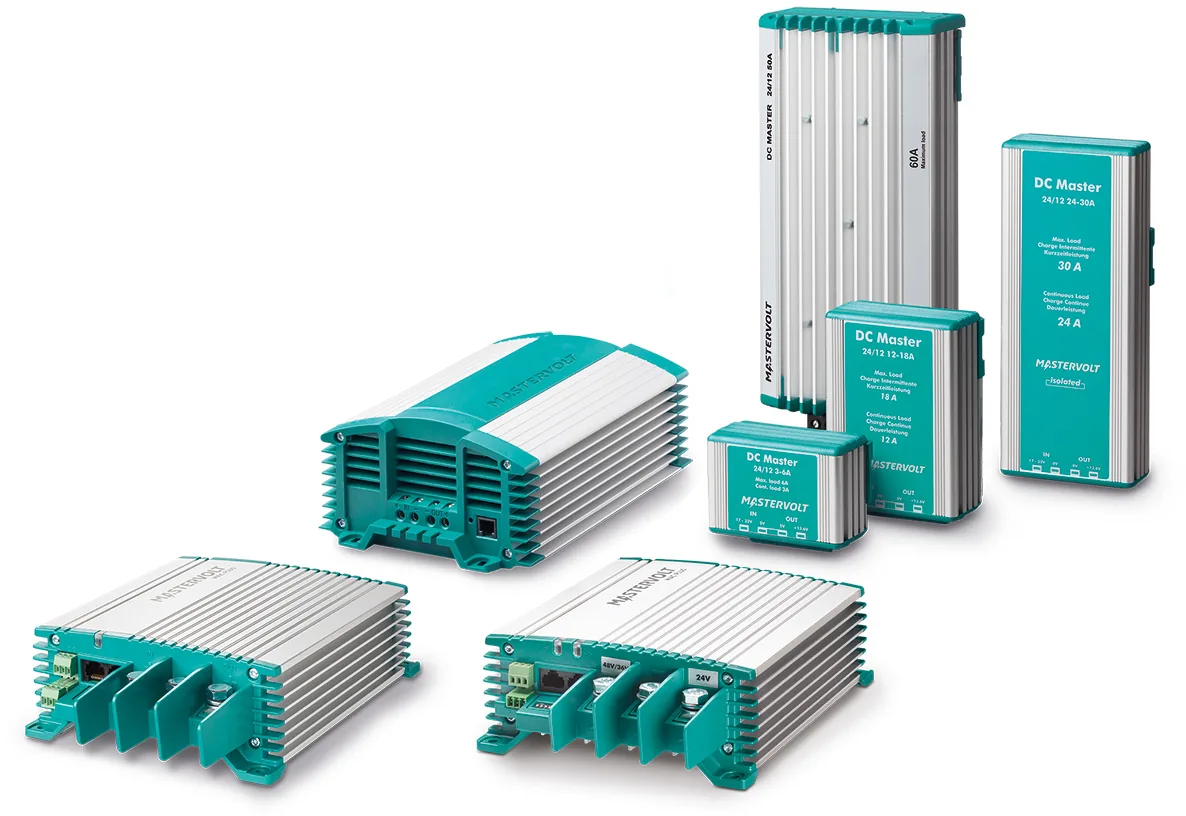
On 7 May 2026 Mastervolt added waterproof 48-volt versions rated IP67 to its Mac Plus range of DC–DC chargers. According to the manufacturer, they are intended for places where the unit is not enclosed in a locker or cabinet, such as open work and fishing boats or an open engine compartment.
The housing is aluminium and the connections sit under a new touch-safe cover. An IP67 rating means the unit is dust-tight and withstands immersion to a depth of one metre for 30 minutes. There is no fan, so it runs in complete silence. It measures 263 x 168 x 75 mm.
Four versions for 12, 24 and 48 V systems
- Mac Plus 48/12-50A: 48 V to 12 V, up to 50 A.
- Mac Plus 12/48-15A: 12 V to 48 V, up to 15 A.
- Mac Plus 48/24-30A: 48 V to 24 V, up to 30 A.
- Mac Plus 24/48-15A: 24 V to 48 V, up to 15 A.
How a bi-directional DC–DC charger works
A conventional DC–DC charger works in one direction only. On the Mac Plus either side can act as input or output, so the charger charges both the house and the starter battery, whichever of them is the source of energy at the time. Mastervolt introduced the bi-directional models two years before the waterproof ones to deal with voltage drop and undercharged house batteries.
The charger detects whether the engine is running, so it does not drain the starter battery while charging the house bank. Several units can run in parallel for a combined charging current of more than 100 A.
Which batteries it charges and how you control it
The charger uses Mastervolt’s 3-step+ charging algorithm, which can recover a completely flat battery, has automatic temperature compensation and stabilises the charging voltage to protect the house battery and sensitive equipment. It suits flooded, gel, AGM and lithium-ion batteries, LiFePO4 included. It works with modern alternators and delivers constant power even when the alternator is not charging.
The Mac Plus connects to MasterBus, CZone and NMEA 2000, so you can monitor and control it from a display on board. It is set up with the DIP switches on the unit, with MasterAdjust or with the CZone configuration tool.
We supply, install and service Mastervolt chargers and DC–DC chargers. Before proposing a charger we check the batteries, the alternator, the cable sizes and where the unit will go. All the equipment for charging and storing energy is on the Power page, and the differences between a charger, an inverter and a combi unit are explained in Boat battery charger: charger, inverter or combi unit. Write to us or call for a proposal.
Frequently asked questions
What does an IP67 rating mean for a charger?
The unit is dust-tight and withstands immersion to a depth of one metre for 30 minutes. That is why it can be fitted in places that are not enclosed in a locker or cabinet.
Why do I need a DC–DC charger if I have an alternator?
Voltage drop in the cables and modern alternators often leave the house battery undercharged. A DC–DC charger stabilises the voltage and charges the battery with the right algorithm, lithium-ion included.
Can I monitor a Mac Plus charger on a display?
Yes. The charger connects to MasterBus, CZone and NMEA 2000, so you can monitor and control it from any display on that network.
Sources
- Pressmare — Mastervolt Introduces New Waterproof Mac Plus Models Featuring Innovative Bi-Directional Technology (7. 5. 2026)
- Yacht — Mastervolt Mac Plus, waterproof 48-volt B2B charger with bidirectional charging technology
- BoatNews — Mastervolt offers an IP67 waterproof version of its Mac Plus 48 V DC-DC charger