From the pontoon pedestal to the boat
Shore power is the path that brings 230 V from the pedestal on the pontoon to your loads. It is made up of the plug at the pedestal, the cable, the inlet on the boat, the main breaker with its protection and the distribution panel. Every link has to carry the current you draw and cope with the damp that is always present at sea.
Most problems do not start in the equipment but at the connections: a plug soaked by rain, a household extension lead lying on the pontoon, or an inlet that has lost its cover.
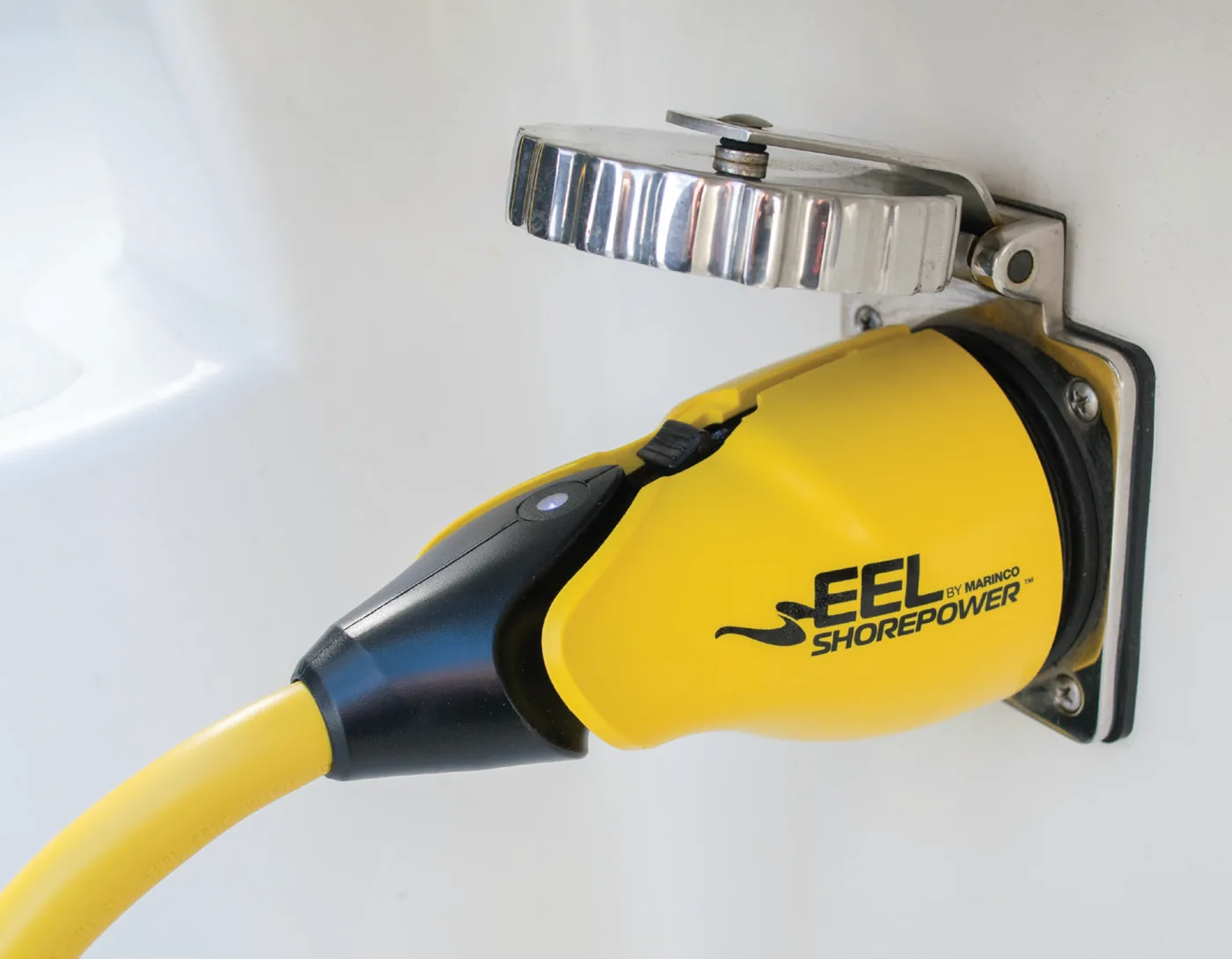
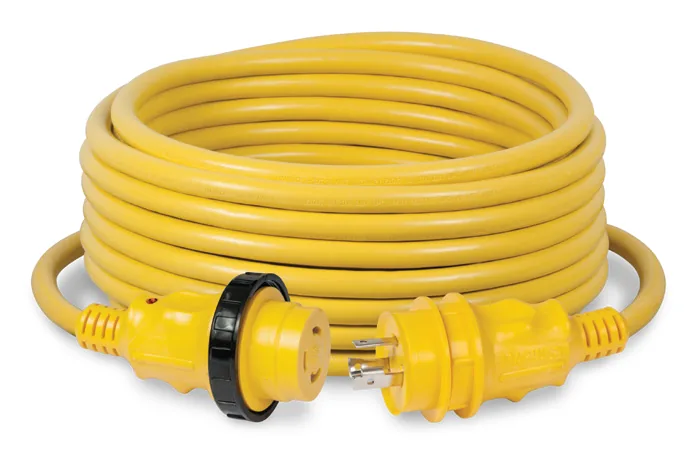
A marine inlet and cordset
A marine inlet has a seal, a cover that closes itself or screws shut, and a housing of stainless steel or tough plastic. A marine cordset has thick, flexible insulation that stands up to sun and chafe, and its plugs lock with a threaded collar so they do not work loose as the boat moves and water cannot reach the contacts.
The cable should be run so it does not hang in the water and cannot be trodden on or pinched between the boat and the pontoon. At the inlet, let the cable drop in a loop so water drips off rather than running into the connection. Marinco makes inlets, cordsets and adapters that fit and seal together.
Protection on board
- A main breaker as close to the inlet as possible, so the cable to the panel is protected too.
- A residual current device (RCD) that trips when current leaks away, for example into the water or through a person.
- A distribution panel with a breaker for every circuit, so a fault on one load does not shut down everything.
- Cables and terminals suited to damp and vibration, and a correctly made protective earth.
Galvanic corrosion through shore power
The protective earth in the shore supply links your boat to the other boats in the marina. Through it and the seawater a small galvanic current can flow, wearing down the sacrificial anodes and underwater metals such as the propeller and shaft faster. A galvanic isolator or an isolation transformer in the shore supply helps prevent this.
If the anodes on your boat wear noticeably faster in the marina than they otherwise would, it is a sign the connection is worth inspecting.
Blue Sea Systems makes switches, breakers and distribution panels, and you will find everything on the Power page. We inspect your connection from the inlet to the panel, propose what to replace and fit it. When you are away from the marina, the sun can charge your batteries; read more in Solar panels on a boat.
Frequently asked questions
Can I use an ordinary extension lead?
It is not recommended. Household leads are not made for damp, salt and sun, and their plugs are not protected against water. A marine cordset with locking plugs is safer and lasts longer.
In what order should I connect the cable?
Switch off the main breaker on board, connect the cable to the boat first, then to the pedestal, and only then switch on. Reverse the order when disconnecting, so the loose end of the cable is never live.
Why does my RCD keep tripping in the marina?
It can be damp in a plug or inlet, a fault in an appliance on board, or an overload when too many appliances run at once. We trace the fault and fix it.