People have sailed the seas for centuries without a watermaker, but with one you can cruise almost without limits and without stops in marinas, where drinking water is usually expensive and often of doubtful quality. Anyone who has crossed the Atlantic or spent a long time at sea knows how much fresh water on board matters.
You make water under way or at anchor, so you no longer depend on the size of your tanks or queue for water in a marina. You can choose your route more freely.
How a watermaker works
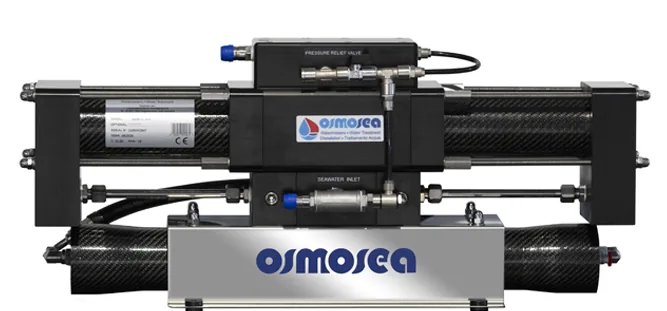
A watermaker works by reverse osmosis. A pump forces seawater at high pressure through a semi-permeable membrane that lets the water pass but holds back the salt and most impurities. The fresh water runs to the tank and the remaining, much saltier water goes back to the sea. Ahead of the membrane, pre-filters remove sand, algae and other particles that would damage it.
Osmosea energy-recovery watermakers reuse part of the energy in the high-pressure brine flow, so the pump needs less power. They run on 12 or 24 V, are quiet, draw from 5 A at 24 V and produce 30 to 150 litres of water an hour. For larger yachts there are automatic watermakers with a high-pressure pump on 230 V.
Why a watermaker rather than a bigger tank
- Space and weight: a watermaker takes up less room than a tank or a supply of bottled water and weighs less, which matters most on smaller boats.
- No rationing: water use no longer needs careful planning, and a rinse after every swim is no longer a question of supply.
- Cheaper in the long run: most modern watermakers need no generator and very little maintenance.
- Crew health: a sufficient supply of water keeps the crew properly hydrated, and good water is available even where the local supply is doubtful.

How to choose a watermaker for your boat
Watermakers differ in output, power draw, voltage and how automated they are: from compact units for sailing yachts and smaller motor boats to fully automatic systems that flush their membranes and can be controlled remotely. Together we look at how much water you need, how much power you have and where the unit would go, then we propose and install the right model.
We size the output to the number of people aboard and how long you stay at sea, and include the power draw in the boat’s power system: for 12 or 24 V units the batteries and charging count, for 230 V units the generator or inverter. The fresh water then runs through the boat’s water system, which we describe in Water pumps for boats: how the fresh-water system works.
Frequently asked questions
Is the water from a watermaker drinkable?
Yes. The membrane holds back the salt and most impurities, so the water is fit for drinking and cooking. The condition is regular maintenance: flushing the membrane and changing the pre-filters.
How do I maintain a watermaker?
The membrane has to be flushed regularly with fresh water and the pre-filters changed, and the system pickled before a long lay-up. We explain it all at handover, and we service the watermaker too.
Can I run the watermaker in a marina?
We do not recommend it. Water in marinas and enclosed bays is often polluted with oil and dirt that can damage the membrane, so run it at sea.