Why a lithium-ion battery needs a safety relay
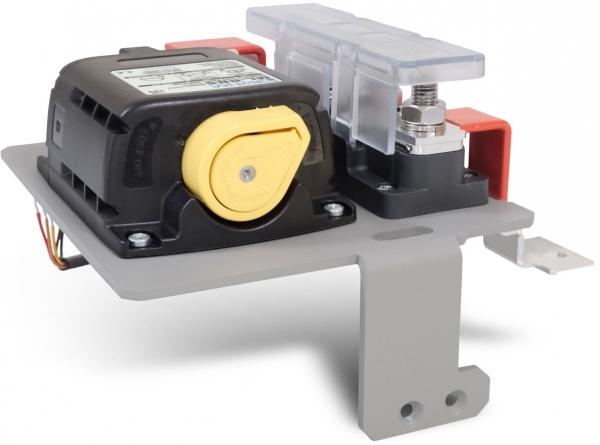
A lithium-ion battery has built-in cell management that watches the voltage and temperature of every cell. If the voltage falls or rises too far, or the temperature leaves the safe range, it must disconnect the battery from the loads and chargers, or the cells can be permanently damaged. That job is done by a safety relay controlled by the battery itself.
Without the relay the management system cannot interrupt the current, so the relay is as important a part of the installation as the battery.
What a class T fuse does
A lithium-ion battery has a very low internal resistance, so a short circuit can draw an extremely high current. A class T fuse is fast and has a very high breaking capacity, so it interrupts such a current safely, which an ordinary fuse may not manage. We fit it as close as possible to the battery’s positive terminal, so it also protects the main cable behind it.
A compact Mastervolt bracket
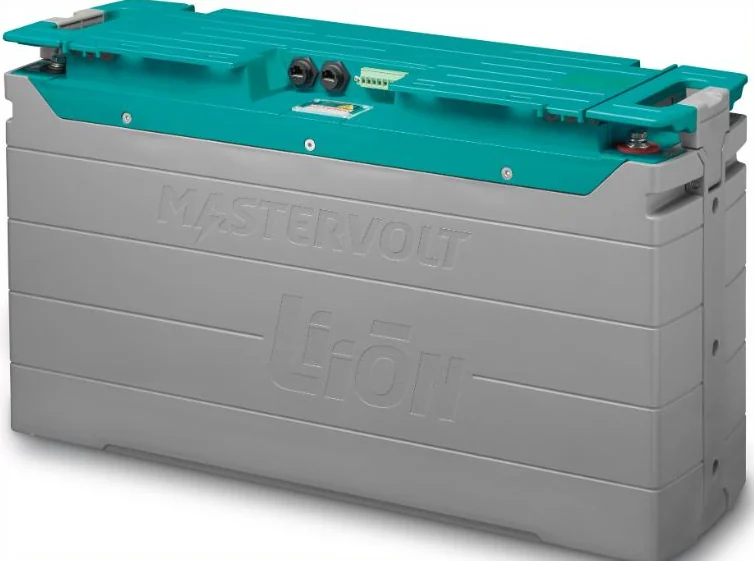
Mastervolt is a leader both in building MLI batteries and in using them safely. For the MLI Ultra 12/2750 and MLI Ultra 12/5500 it makes a compact bracket that carries the safety relay and the class T fuse. It mounts simply on top of the battery and also comes in a 24-volt version.
What a safe lithium-ion installation includes
- a safety relay controlled by the battery’s management system
- a class T fuse as close as possible to the positive terminal
- cables of the right size and secure, properly tightened connections
- a charger and solar regulator set up for lithium, and a DC–DC charger through which the alternator charges the battery safely
- state-of-charge monitoring with timely alarms
Upgrading to lithium
When you move to lithium we review the whole power system, from chargers and alternator to solar panels and loads, so the batteries work safely and last. We explain how to choose a charger that knows your batteries in Battery chargers for boats: charger, inverter or combi, and how to measure state of charge in Battery monitoring on a boat: state of charge and tanks. If you are considering an upgrade, please call us.
Frequently asked questions
Can I simply swap my lead-acid batteries for lithium-ion?
Not without reviewing the system. The charger, alternator, fuses and monitoring have to be adapted so the battery works safely and reaches its expected service life.
Where does the class T fuse go?
As close as possible to the battery’s positive terminal, so it protects the whole cable behind it. On the MLI Ultra 12/2750 and 12/5500 the Mastervolt bracket on top of the battery makes this possible.
What happens when the safety relay disconnects the battery?
The loads and chargers connected through the relay lose power, and the cells are protected from damage. That is why we set the system up to warn you of a low state of charge in good time.