How AIS works
AIS is the Automatic Identification System. Boats fitted with an AIS transponder regularly broadcast their details on two dedicated VHF channels: name, MMSI number, position, course and speed, and ships also their destination. Any receiver in range picks this up and displays it. Larger ships carry AIS under international rules, and more and more leisure boat owners fit it too.
Because AIS uses VHF frequencies, its range is similar to a VHF radio’s and depends mainly on antenna height. It is important to know that AIS only shows vessels that transmit. Small boats without a transponder will not appear on screen, so AIS is no substitute for a good lookout and radar.
Receiver or transponder
An AIS receiver only receives: you see other vessels, but they do not see you. It is the simplest way to start, especially if you already have a plotter. A transponder receives and also broadcasts your own boat’s details, so ships and other AIS-equipped boats can see you. Leisure boats use Class B transponders.
A transponder needs your boat’s MMSI number and its own GPS position source, and we enter the boat’s details when we install it.
AIS on a boat, shown on the chartplotter
AIS is at its most useful when targets appear on the chartplotter alongside the chart and your own heading. The plotter works out when and how close you will pass another vessel, and warns you if the gap will be too small.
The data reaches the plotter over the navigation network; read more in NMEA 2000: one network for all the data on board. Some fixed VHF radios have a built-in AIS receiver and show targets on their own screen or pass them on to the plotter.
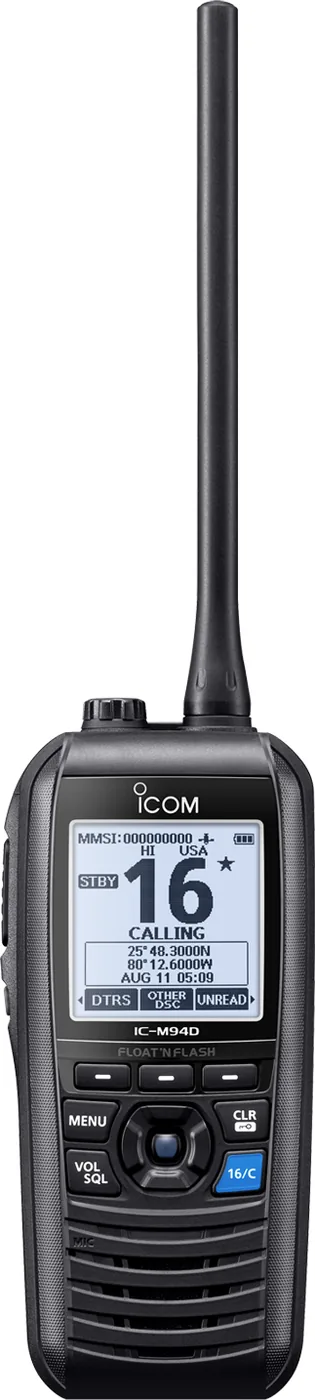
A handheld with AIS
If you do not have a fixed system yet, or want a backup, a handheld VHF with a built-in AIS receiver is a sensible choice. Alongside the usual handheld functions, the Icom IC-M94DE shows nearby AIS vessels on its own screen. It suits smaller boats, a helm without a plotter, and extra safety in the tender.
You will find all Icom radios on the Navigation and communication page, and more on choosing between a fixed and a handheld set in VHF radio on a boat. We look at your navigation and antennas, propose a receiver or transponder, install it, connect it to the plotter and enter your boat’s details.
Frequently asked questions
Do I need an MMSI number for AIS?
Not for a receiver, which only listens. A transponder needs one, because it uses it to broadcast your boat’s details.
Do I need a separate antenna for AIS?
Not necessarily. AIS can have its own antenna or share the VHF antenna through an antenna splitter. Which is better depends on the boat and the equipment.
Can others see me if I only have a receiver?
No. A receiver shows other vessels but does not broadcast yours. For ships and other boats to see you, you need a transponder.