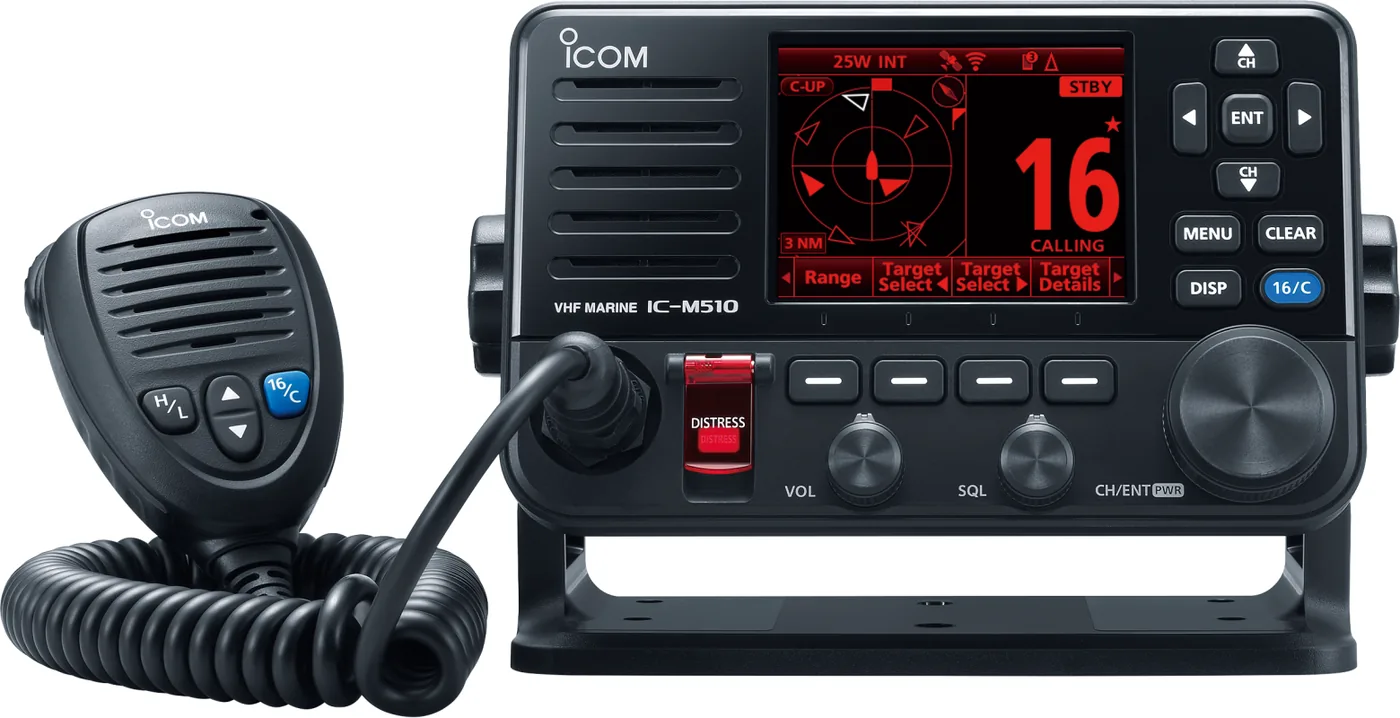
Fixed-mount radio
A fixed radio has more transmit power and an antenna high on the mast or superstructure, so it reaches further. Connected to GPS, its DSC function sends a distress call with the boat’s position at the press of a button. DSC needs an MMSI number for your boat.
Some fixed radios have built-in GPS or AIS reception, or can also be controlled from a phone. Icom, founded in Osaka in 1954, is one of the leading makers of marine radios.
Handheld radio
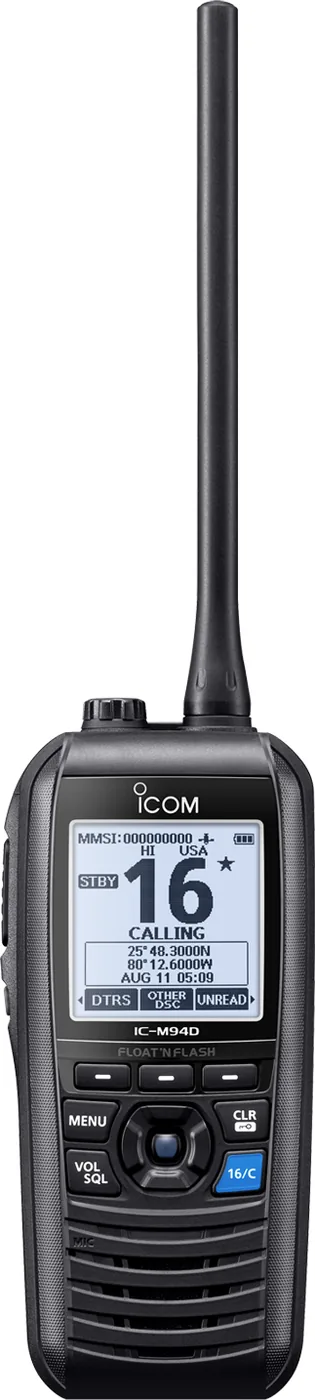
A handheld has less range, but it goes with you into the tender, onto the pontoon or into the liferaft. Floating models are practical at sea, and some also have GPS and DSC. The Icom IC-M94DE also has a built-in AIS receiver.
What DSC is and how a distress call works
DSC (Digital Selective Calling) lets a radio send a digital call to another station or to everyone in range. When you press the distress button, the radio automatically transmits the boat’s identity and GPS position, and DSC radios nearby and coast stations receive it with an alarm, even if nobody is listening to channel 16 at that moment. DSC also lets you call a specific boat without calling on the shared channel.
Do I need a licence for a VHF radio
As a rule you need a radio operator certificate, such as the SRC, and the station registered with an MMSI number. The exact requirements depend on the boat’s flag state, so we check them with you. For vessels that must meet survival-equipment rules there are GMDSS radios, for example the Icom IC-GM1600E survival-craft handheld.
Our recommendation: both
On most boats that go beyond the coast we recommend a fixed radio as the main set and a handheld as backup. We install the radio, connect it to the navigation and antenna, set up DSC and check the range. All models are on the Navigation and communication page.
How far the radio reaches depends mostly on the antenna, which we cover in VHF antennas on a boat: height, cable and installation for more range. Receiving and transmitting vessel data is covered in AIS on a boat: what it is and whether to choose a receiver or transponder.
Frequently asked questions
Which channel do I use in an emergency?
Channel 16 is the international distress and calling channel. Radios with DSC can also send a digital distress alert with your position.
What is an MMSI?
An MMSI is a nine-digit identity number for the boat, used for DSC digital calls and AIS. It is entered into the radio before DSC can be used.
Can I connect the VHF to my chartplotter?
Yes. Fixed radios connect to the navigation over NMEA to receive the GPS position, and some models also share AIS data.