Why voltage alone misleads
Most owners judge their battery by its voltage. The trouble is that voltage moves with the current flowing at that moment: it drops when the fridge or windlass runs and rises while you charge. It is only reliable after the battery has rested for a while, which rarely happens on a boat where something is always on.
With lithium-ion batteries the voltage stays almost the same from full to nearly empty, so it gives almost no indication of the state of charge. Read more about these batteries in Lithium-ion batteries: a safety relay and a class T fuse.
State of charge with a shunt
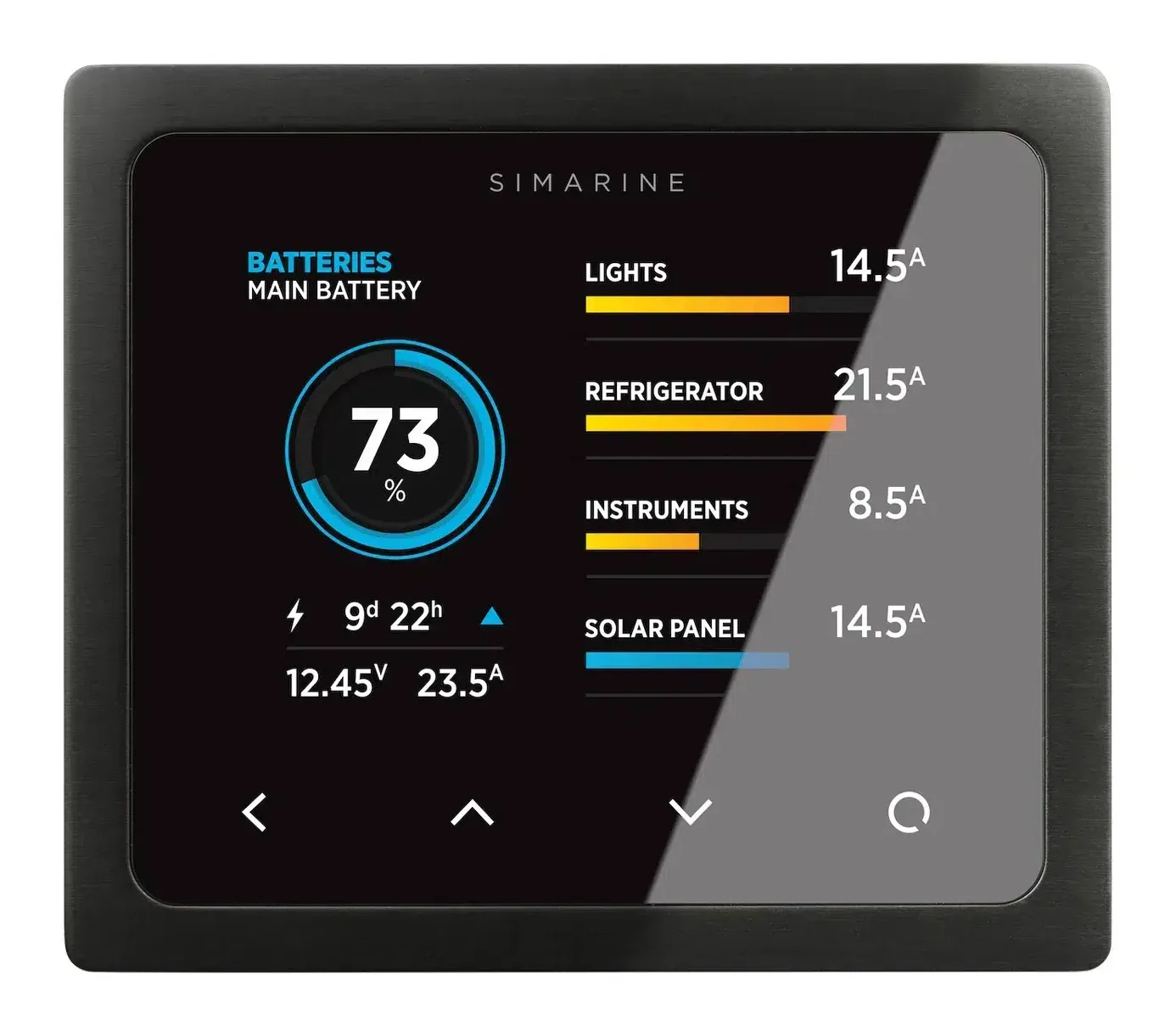
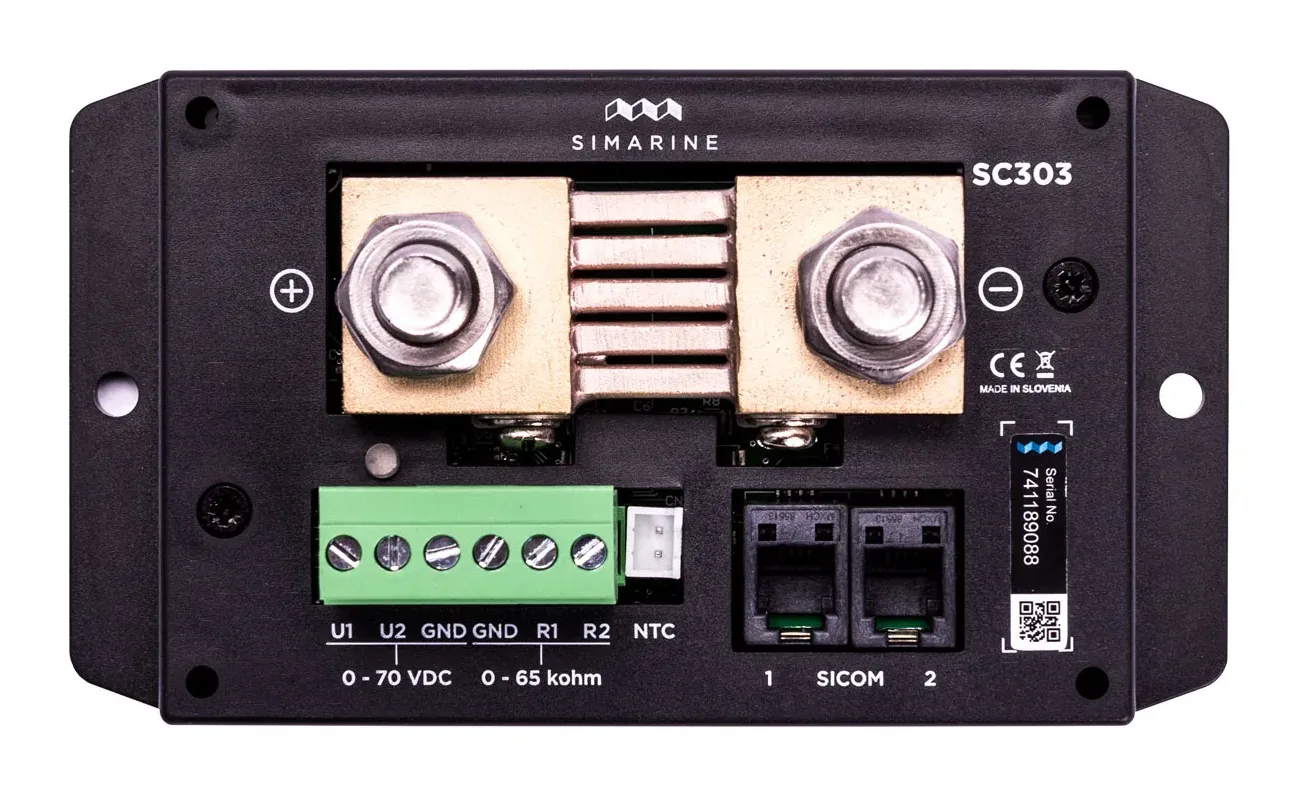
A shunt is a measuring resistor fitted in the battery’s negative cable, so that every amp going into or out of the battery passes through it. The system keeps count of the energy in and out and works out the state of charge as a percentage, along with how long the battery will last at the present load. When you also monitor individual loads, you quickly see what is draining the battery, such as the fridge, the lights or the instruments.
The Simarine shunt also has inputs for extra voltages, level senders and temperature, so one module often covers several measurements at once.
Tank level senders
For fuel, fresh water and waste we choose a sender that suits the tank. Classic float senders are simple but have moving parts in the liquid. A radar sender measures the level from above without touching the contents, which is a particular advantage in a waste tank.
Tanks on boats are often irregular in shape, so we calibrate the sender after fitting so the percentage shown matches what is actually in the tank. That way you know in good time when to refuel or pump out.
One display and alarms
The PICO monitor from Slovenian company Simarine shows batteries, loads, solar charging and tanks on one screen, and you can follow the same data on your phone. You can set alarms, for example when the state of charge falls below a chosen level or the waste tank is nearly full.
Through the NMEA2000 Gateway the same data also appears on the chartplotter. Read how such a network works in NMEA 2000: one network for all the data on board.
We start by looking at your batteries, loads and tanks, then propose the sensors and connect them into one clear system you can read at a glance. All our monitoring solutions are on the Monitoring and control page. Send us a description of your boat or call us.
Frequently asked questions
Does a shunt work with lithium-ion batteries?
Yes, and it is especially useful there, because voltage says almost nothing about their state of charge. We set the battery type and capacity in the system.
Can I keep the existing tank senders?
Often, yes. Simarine accepts signals from classic resistive senders, so we check the ones you have and, if they work, connect them to the new system.
Can I monitor several batteries at once?
Yes. The PICO monitor takes several battery banks, for example house, engine start and thruster batteries, and shows each one separately.