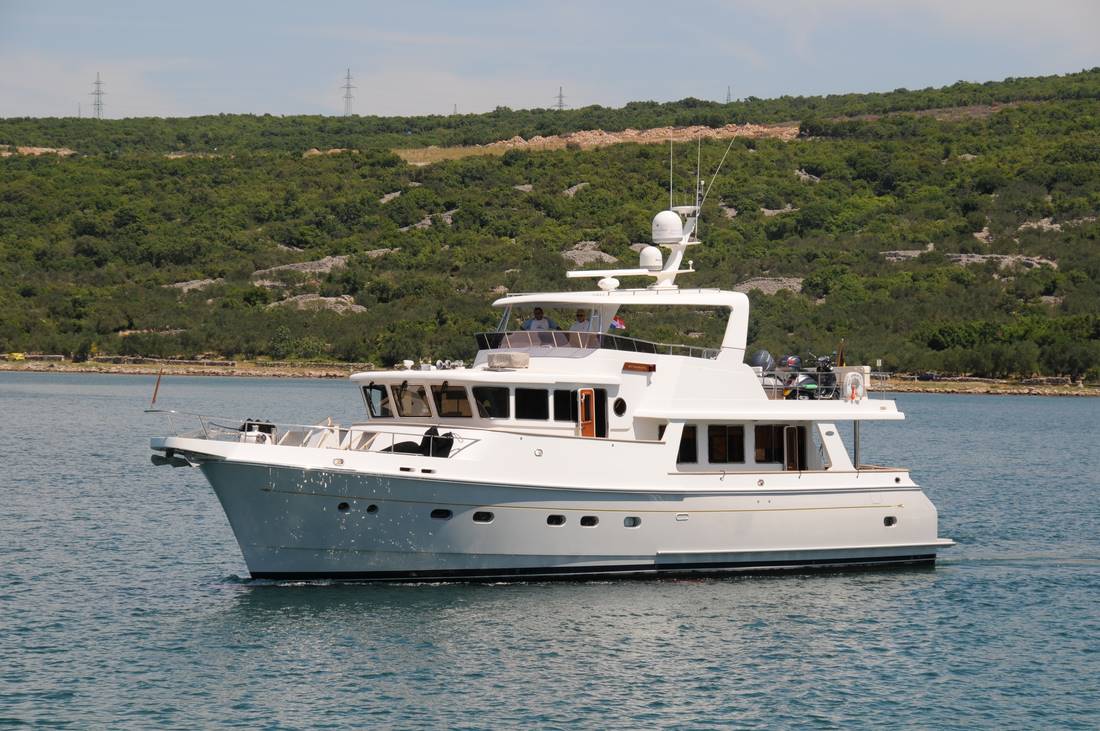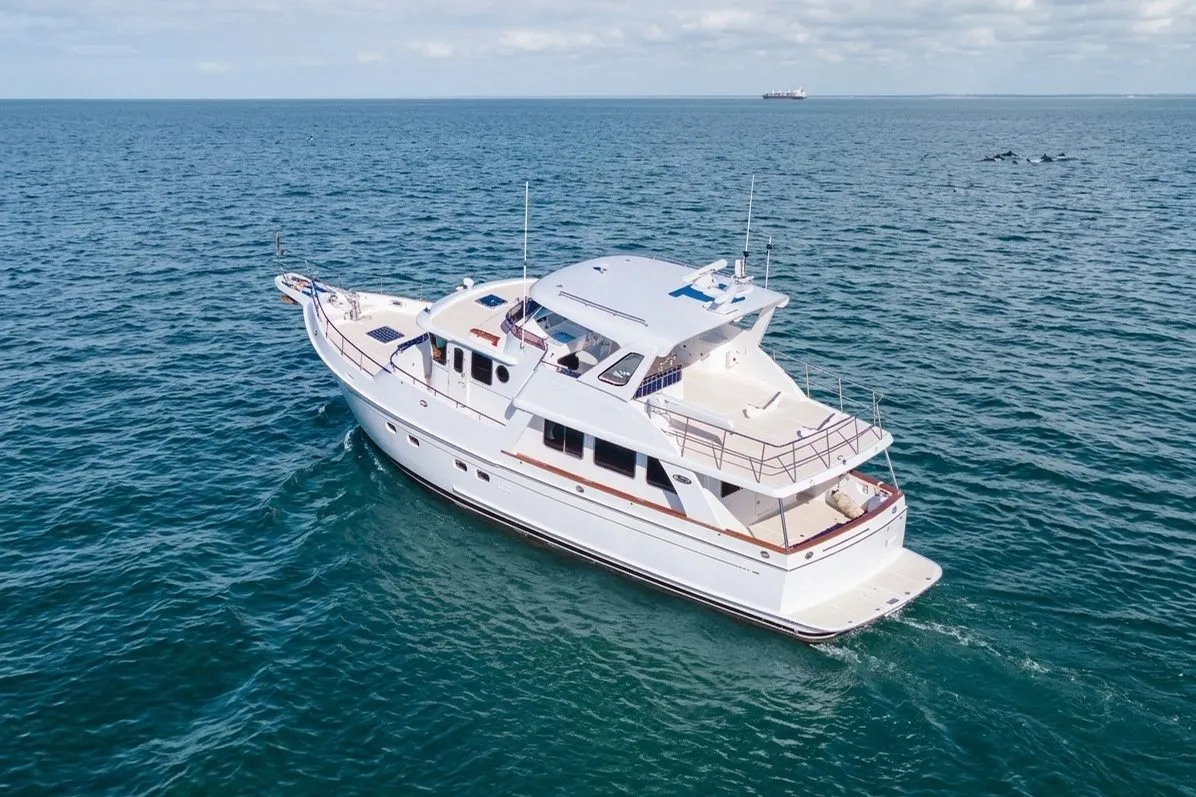
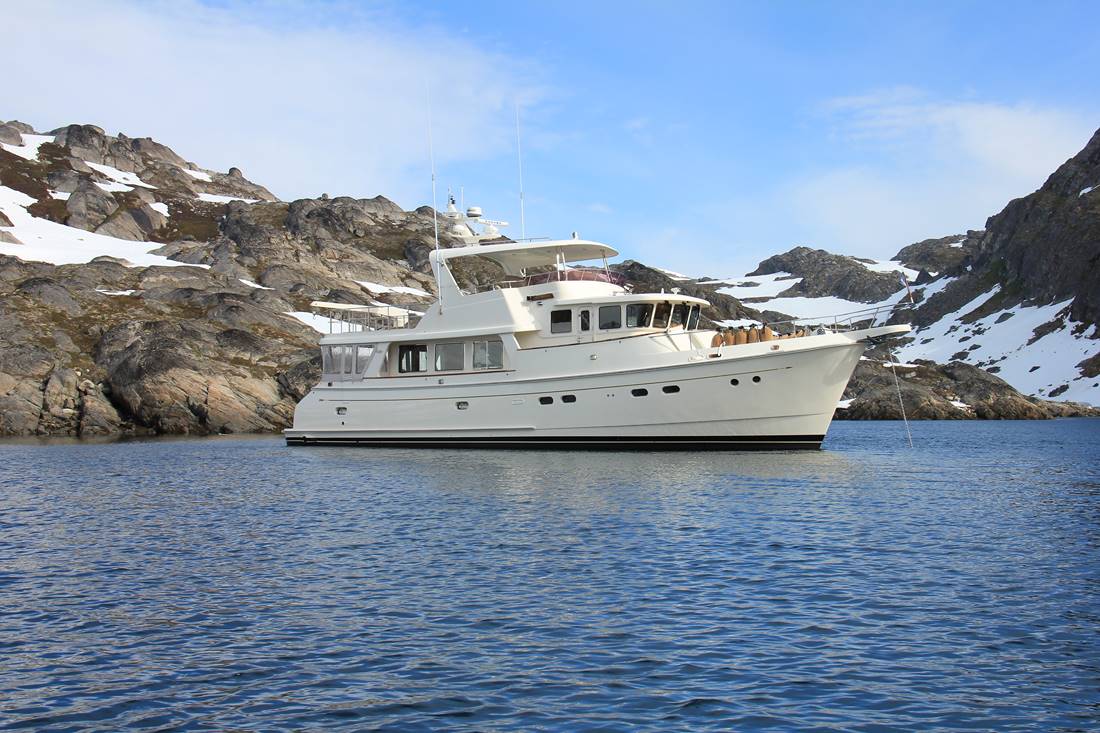
A complete Furuno navigation suite with Simrad backup, and Kabola central heating that runs off the engines while under way.
What we did
- Complete Furuno navigation suite
- Simrad backup navigation
- Kabola central heating: an oil burner heats via radiators, and under way via a heat exchanger on the engines
- Crossed the Atlantic by the northern route on our installation
What an Atlantic crossing asks of a motor yacht
On an ocean passage the boat spends days on end far from the coast, from service and from spare parts. The crew keeps going at night, in poorer visibility and in changeable weather, so every device must work all the time, not only in fine weather near a marina.
The Selene 60 is a 19.84 m trawler built on a mould with the Selene Deep Hull™ structure, with tanks for 7,570 litres of fuel and 2,271 litres of water. The boat is designed for long passages, and the equipment has to be as dependable as the hull.
Navigation for the ocean: a main and a backup system
We built the main navigation on Furuno equipment. When the whole navigation suite comes from one maker, the devices work together smoothly and the crew learns one way of operating every display.
The Simrad backup navigation is a separate system. If the main navigation stops working because of a fault, a power problem or moisture, the crew still has a second, independent system and can carry on safely. On the ocean, where there is no nearby marina to turn into, a backup like this is part of basic safety, not an extra.
What equipment on an ocean passage must do
- Key systems have a backup, separate from the main one, so a single fault cannot take out both.
- The displays at the helm are clear and readable by day and by night.
- The wiring is tidy and labelled, so the crew can quickly trace a problem at sea.
- The crew knows the equipment and can operate it before departure, not only once at sea.
Heating on the northern Atlantic route
The northern route across the Atlantic runs at higher latitudes than the trade-wind route, so the sea and the nights are colder and moisture builds up quickly inside the boat. A warm, dry boat means the crew can properly rest between watches and the berths and clothing stay dry.
The Kabola central heating uses an oil burner to heat the rooms through radiators. Under way the heat comes from a heat exchanger on the engines: it uses the heat the engines produce while running, which would otherwise be lost. The burner therefore does not need to run all the time on passage, while in a marina or at anchor it heats the boat itself.
On this boat it was a complete fit-out for an ocean passage, and we take the same approach to smaller jobs: first we look at what the boat already has and where it will go, then we propose the equipment. You will find more about navigation equipment on the Navigation and communication page, and about communication offshore in VHF radio on a boat: fixed, handheld or both and AIS on a boat. If you are preparing a boat for a longer passage, write to us or call us.
Frequently asked questions
Does a boat crossing an ocean need backup navigation?
We recommend it. A backup system that is separate from the main one lets the crew carry on safely if the main system fails. On this Selene 60 that role is filled by a Simrad system.
How does heating through a heat exchanger on the engines work?
Under way the exchanger transfers heat from the engines into the heating circuit that feeds the radiators. When the engines are off, the oil burner heats the boat.
When should I start preparing a boat for a long passage?
Early enough for the installation to be finished and tested before departure, and for the crew to get to know the equipment on shorter trips.